
The essay below is based on research by Year 10 student Sia Nair for her Gold Arts Award. Sia’s chosen topic is Bharatanatyam and her research involved interviewing eminent dance artists and teachers in UK and India along with reviewing scholarly dance articles.
Essay Topic:
Should Bharatanatyam remain exclusive and classical or should it evolve to become inclusive and accessible?
Dance is an abstract art form. When an audience with no dance background is watching a dance performance, they may not be able to completely understand the narrative being shown and may only understand some of the emotions being expressed. Being a Bharatanatyam dance student myself, I was curious to know whether other dance artists felt that Bharatanatyam should remain abstract or if the audience should fully be able to understand the story being performed (e.g having a narrator tell the story as the dance progresses). This led me to interview a few dance artists including Ananya Chatterjee of Kalakunj, Pushkala Gopal MBE (previous head of ISTD Bharatanatyam faculty), Vanessa Pesci (my GCSE Dance Teacher) and Lucy Bayliss (Head of Creative Programmes at Dance East). In addition, I also wanted to know whether Bharatanatyam should remain traditional and classical or evolve to become more relevant to audiences. This is the basis of my question for this essay ‘Should Bharatanatyam remain exclusive and classical or should it evolve to become inclusive and accessible?’
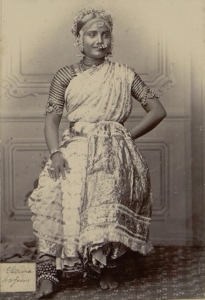
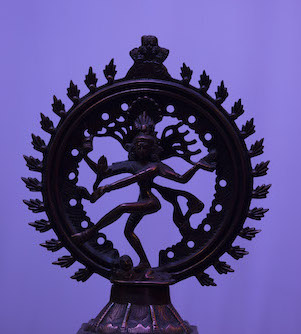
Left: An image of a Gnyana- aTanjore Sadir dancer. Right: The iconic Nataraj statue.
Bharatanatyam and its precursors is an Indian classical dance style that is over 2000 years old. It was created from the ancient Sanskrit scripture on Indian performing arts, the Natya Shastra which was written by sage Bharata Muni. It originated in Tamil Nadu, India and was originally a temple dance performed by devadasis. Devadasis were women who dedicated their lives to worshipping Hindu Gods and Goddesses in temples by performing rituals and ceremonies, which involved performing Bharatanatyam (then known as Sadir, Sadir Attam or Dasi Attam).The dance style includes rigorous movements, rhythmic footwork, intricate hand gestures, dramatic facial expressions and storytelling.
These stories were often about Hindu epics such as Ramayana, and the dance form used poses seen in temple sculptures such as the Nataraja pose from the Chidambaram Temple in Tamil Nadu. In addition, Sadir also had erotic aspects as part of the shringara rasa. Bharatanatyam or Sadir as it was then known, was first formalised by four brothers from Tanjore: Chinnayya, Ponnayya, Sivanandam and Vadivelu, commonly known as the Tanjore Quartet. These brothers structured the dance into the repertoire (the Margam) that we know today, formalised the fundamental techniques, and the type of music and songs that accompany the dance pieces. During colonial rule, the British Raj banned the devadasi system which included Sadir, resulting in a decline of the art form. To revive the artform and simultaneously meet societal norms of early 20th Century British India, Rukmini Devi Arundale adapted Sadir to the Bharatanatyam form we know today. The erotic aspects of Sadir, which included parts of the Shringara rasa, were stripped away, but the formalised structure that was developed by the Tanjore Quartet was maintained. Rukmini Devi founded the Kalakshetra International Academy of Arts and since then, Bharatanatyam has continued to thrive and develop.
What makes Bharatanatyam a classical and traditional art form?
According to the Cambridge Dictionary, the definition of classical is “traditional in style or form, or based on methods developed over a long period of time, and considered to be of lasting value.” This aligns with Bharatanatyam and its precursors, since it is 2000 years old. The dance style has developed over the centuries from being an art form performed only in temples, to now being performed globally in theatres and non-conventional spaces. In addition, according to Pushkala Gopal, “people should keep it as classical as possible if they are dancing in a temple.” which suggests that one of the things that makes Bharatanatyam classical is its connection with temples. Furthermore, it is definitely a traditional style because it is derived from the Natya Shastra and was performed by devadasis. I further noted its ancient roots during my visits to old temples and ancient sights in India (for example, my visit to Ajanta caves which were carved from the beginning of the 2nd century BCE) where I observed sculptures in poses that I perform in my Bharatanatyam repertoire. This shows that this dance style is deeply rooted in Indian culture and religion for millenia and hence, is a classical and traditional performing art form.
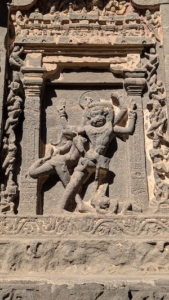 Left: A dancing pose from the Ajanta and Ellora caves from my visit in 2024
The revival of Bharatantyam
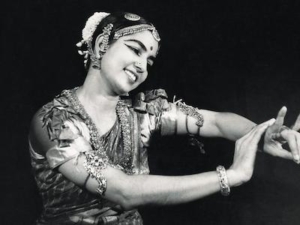
My experiences above made me realise how far this dance style has evolved and developed to its present form. During the early 20th century, the British Raj banned temple dancing – which included Sadir- because they viewed devadasis as prostitutes and wanted to create a more western influence in India.
In the 1930s, when Rukmini Devi Arundale revived Sadir, she adapted and modernised the art form as Bharatanatyam so that it was more acceptable in a society under colonial rule. She did this by eliminating erotic gestures, making movements inspired by ballet, introducing musical instruments, stage and lighting design, and costume and jewellery inspired by temple sculptures.
Above: Rukmini Devi Arundale. The reviver of modern day Bharatanatyam
The global spread of Bharatanatyam
Over the years, Bharatanatyam has spread globally due to several factors such as migration, technology/media, increased number of dance schools and organizations that promote Indian culture and heritage including this artform. Dance and music are an integral aspect of Indian culture. For example, Bharatiya Vidya Bhavan (Bhavan), an educational organisation promoting Indian culture and art, was founded in 1938 in India and it now has 110 centres worldwide in countries such as the UK, USA, Australia, UAE, Kuwait and Qatar. This organisation conducts classes of Indian fine arts including Bharatanatyam to train students and pass on knowledge of Indian performing arts. In addition, the Bhavan in most countries around the globe offers a space for people to watch live Indian art performances 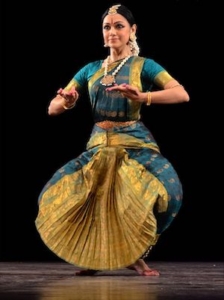 by eminent dance and music artists. I had the opportunity to watch one such live performance by a famous Indian Bharatanatyam dance artist named Rama Vaidyanathan.
She had come from India to the Bhavan, UK to present her new dance theatre piece called Ratnagarbha, which allowed me and many other connoisseurs to engage with Indian classical dance.
Thus, organisations such as the Bhavan in the UK and other countries, have allowed people of Indian heritage to connect to their roots. It is potentially also a great way to expose people from non-Indian backgrounds to Indian culture and arts. However, for this to happen, I believe that Bharatanatyam may need to evolve in order to connect with such an audience. So should Bharatanatyam, to an audience of non-Indian heritage, remain abstract and be left for interpretation?
Above: Rama Vaidyanathan, an eminent Bharatanatyam dance artist
Although Bharatanatyam has spread globally, it could be argued that it needs to evolve to connect to audiences of non-Indian heritage. During my interview, Lucy Bayliss said that an “audience” who feels “there’s a narrative” will “really seek to try and understand it.” I received a similar response to this from Vanessa Pesci, who said that “I personally like to have prior knowledge of what I am watching as I enjoy looking for the links to the narratives and themes within a dance style.” This shows that some people may want to understand the meaning of what the dance is showing. Vanessa Pesci also gave an alternate view saying that “others like to be able to draw their own conclusions so it is a very personal choice.” This shows that others may want to just enjoy the aesthetics and make their own interpretations instead of knowing the story prior to the performance. Also, if the dance show was meant to be understood by an audience then “It’s the job of the artist to tell a story well for an audience.” according to Lucy Bayliss. This means that it’s the artist’s choice to decide whether they want the audience to interpret the show themselves or understand the artist’s perspective. Moreover, Lucy also said that it is the artist’s job to think who their target audience is and how they are going to communicate effectively to them. This could be done through “their movements, storytelling and expressions.” Furthermore, a dance may also need to include props or a narrator since “Sometimes stories are very complex.” Therefore, it is the artist’s choice and intentions on how they want the audience to connect with the dance piece whether through their own interpretations or understanding the piece through effective communication which may need to use theatrical devices. Hence, in some situations Bharatanatyam may need to evolve and in other situations it may not need to be based on the artist’s vision, but left for audience interpretation.
Does Bharatanatyam need to remain classical?
Quoting Pushkala Gopal, “people won’t call it Bharatanatyam if it doesn’t resemble its parent.” This made me realise that Bharatanatyam to this day, is classical and should remain a classical art form because if it evolved by losing its traditional repertoire, it would become a non-classical dance form that can no longer be called Bharatanatyam. An example of this is Contemporary dance, which evolved by fusing classical Ballet and Modern Dance forms. Contemporary is a completely different dance form which shows that if Bharatanatyam became non-classical it would become a different dance form. Likewise, when Rukmini Devi Arundale removed erotic movements from Sadir to adapt the art form to make it acceptable during that period the name was changed to Bharatanatyam. However, unlike Contemporary dance, Bharatanatyam still maintained the classical aspects codified by the Tanjore Quartet, and did not completely evolve into a new dance style. Therefore, one can argue that changing the dance style over time does not necessarily eradicate the traditional aspects of the dance form. This shows that we could continue to adapt Bharatanatyam to suit the future generations whilst retaining its true value.
Is Bharatanatyam inclusive and accessible in its classical form?
As a classical art form, Bharatanatyam is inclusive since the Natya Shastra describes the arts performed by both men and women. More specifically, the text has details on Tandava (brisk, rhythmic movements performed by the Hindu God Shiva typically performed by men) and Lasya (graceful, elegant movements performed by the Hindu Goddess Parvati typically performed by women) which are both included in Bharatanatyam. These two elements (Tandava and Lasya) in Bharatanatyam can be performed by any dancer regardless of their gender to embody different characters and roles.
Traditionally, Nattuvanars (currently people responsible for setting the rhythm of a Bharatanatyam dance performance using cymbals), who were originally only men, were dance instructors and choreographed the dance for the devadasis. According to D.B.S Jeyaraj, in the past, Nattuvanars and devadasis, exclusively belonged to the hereditary community from the IsaiVellalar caste. No other communities were involved with practicing the art form, showing that it was exclusive to a section of society and also had gender separated roles. When Rukmini Devi Arundale revived Bharatanatyam, she made it more inclusive, by teaching the art form to people from outside the IsaiVellalar caste. Additionally, Rukmini encouraged men to perform Bharatanatyam and not just be the musical accompanist. She also encouraged women such as Kamala Rani to learn Nattuvangam (rhythm for the dance recital using cymbals) and become a Nattuvanar. Therefore, after revival it could be argued that Bharatanatyam became more inclusive. However, does inclusivity in Bharatanatyam only refer to gender equality? Or should it also include practitioners who do not have a South Asian heritage?
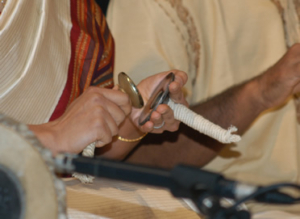 Left: The art of nattuvangam, the use of cymbals to orchestrate the dancer and the musicians during a live performance keeping the rhythmic cycle intact.
Some people argue that it is more inclusive currently than previously (before British rule) due to becoming more accessible globally. Before the British Raj, Bharatanatyam remained in India and had not spread to other parts of the world; so there were only Indian practitioners of the art form. However, due to migration, media and established dance institutions such as the Kalakshetra, Bharatanatyam has spread internationally and is being performed worldwide. Furthermore, not only has it reached other countries, it is being performed by professional bharatanatyam dancers of non-Indian heritage such as Irina Iskorostenskaia (Russian heritage), Kassiyet Adilkhankyzy (Kazakh heritage) and Silivia Rissi (Argentinian heritage). In addition, I referred to the Akademi (South Asian dance organisation) website to see the number of Bharatanatyam dance schools in the UK. I found that there are 10 schools in South East England and London itself has 26 Bharatanatyam dance schools. I am also aware of 7 Bharatanatyam dance schools in Cambridge alone. This shows the demand for the artform and how it has progressed globally making it quite inclusive. Moreover, since Rukmini Devi Arundale’s revival of the dance style, the dance form is no longer performed only in temples but is now performed in theatres. An example of this is the Bharatanatyam-based dance drama Magical Honey. Magical Honey is about this girl called Maya who loves to read and draw, and is super enthusiastic about school but when she meets the celestial being Saraswati she learns to unlock the true magic inside her. Together they go on a journey exploring their beautiful world and fight the evil headmistress Miss Tusra. Unlike traditional Bharatanatyam repertoire which heavily relies on Indian mythological themes, Magical Honey is a contemporary work with a modern storyline using the traditional Bharatanatyam movement. Furthermore, it includes a narrator who narrates the story, in English, as the dance progresses which makes it easier for audiences to understand, making it great for families. Thus, adapting Bharatanatyam to more modern themes allows people from other cultural backgrounds to engage with the artform thereby making it more inclusive and accessible.
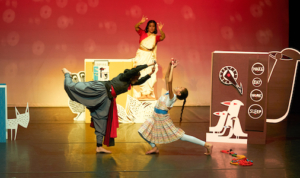 Left: Bharatanatyam in a contemporary context. A still from UK based dance company’s production Magical Honey. Image courtesy: Simon Richardson.
Overall, Bharatanatyam was and is inclusive as a classical dance style but practitioners should continue to “make it more inclusive and accessible to all cultures and communities.” according to Ananya Chatterjee, whilst “retaining and protecting its authenticity” quoted by Vanessa Pesci.
How and why do western classical dance styles such as Ballet have more impact and influence on audiences globally than Bharatanatyam?
From my interviews, Lucy Bayliss says “western culture has been more dominant”, Ananya Chatterjee says that one of the factors is due to “historical development” and Puskala Gopal says that this is due to the “physical domination of the West going and subordinating other countries”. The common theme from all 3 statements was that western history and culture was responsible for the popularisation of Ballet, globally. Furthermore, history has had a negative impact on Bharatanatyam since it went through a difficult phase when the British Raj banned the art form which slowed the progress of the dance style’s development. Another reason why Ballet is more well known than Bharatanatyam is because it has had “a history of works being made famous.” with people going to watch “Swan Lake over and over again” quoted by Pushkala Gopal. In comparison, Bharatanatyam is constantly evolving. “With Bharatanatyam things are very changeable.” “What people used to perform 20 years ago” has changed and “today they bring to the stage something different” quoted by Pushkala Gopal. This shows that Bharatanatyam has no set of famous pieces that people can go and see multiple times unlike Ballet. This impacts the prominence of the art forms as the familiarity of the same Ballet dances being performed makes it a tradition. This repetition of pieces throughout the years, makes Ballet more memorable compared to Bharatanatyam.
Conclusion
Before doing my research, in my opinion, I felt that Bharatanatyam should remain classical but not exclusive and should evolve to become inclusive and accessible not only to Indians, but also people from other cultural backgrounds. I also thought a balance between traditional pure classical pieces and new modern Bharatanatyam pieces would be a great way to evolve the art form whilst maintaining its classicism and cultural roots. After my research, I partially disagree with the question ‘Should Bharatanatyam remain exclusive and classical or should it evolve to become inclusive and accessible?’ because I have realised that Bharatanatyam was never exclusive as an art form since both men and women were involved in the early stages of the dance style. Additionally, it has always been constantly evolving to become more inclusive and accessible. Over the years, it has spread internationally and is now being performed in theatres -not just temples- and non-conventional spaces, to reach more audiences. New pieces are also being created, for example Magical Honey, which uses Bharatanatyam movement, but is set to non-traditional music and is not performed in the classical Bharatanatyam format. Furthermore, I have realised that it is the artist’s choice on whether their Bharatanatyam piece should be adapted for the audience to understand the story or whether the audience should make their own interpretation based on pure movement.
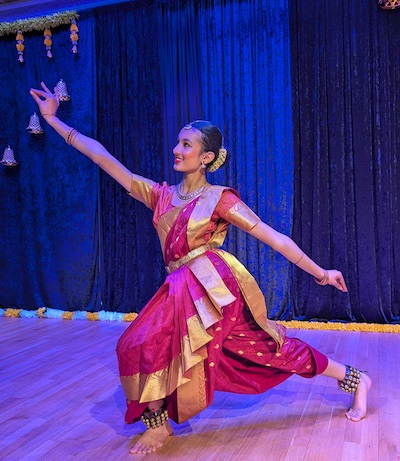
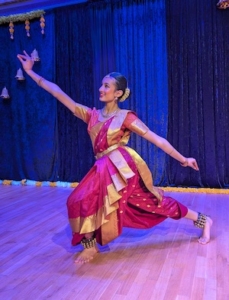 Left: An image of myself performing a dance piece from the classical Bharatanatyam repertoire in Cambridge.
I still believe that Bharatanatyam should remain classical because otherwise,it would not be Bharatanatyam. However, I think that it can adapt over time to meet the needs of the people as society grows and develops. To conclude, I think Bharatanatyam has always been evolving, is inclusive and is quite accessible because it is performed by both men and women and has spread globally to venues that are visited by many whilst preserving its historical significance and maintaining its traditional roots.
Interviewees for my research:
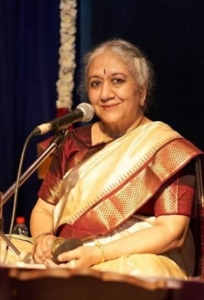
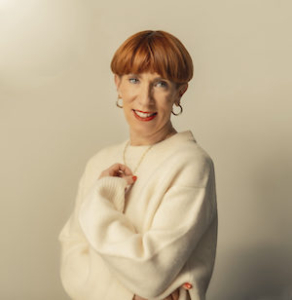
From left to right:
Top panel: My interviewees for this research essay. Pushkala Gopal, MBE, Founding faculty of ISTD Bharatanatyam, UK and India. Centre: Lucy Baylis, Former head of programming, DanceEast, UK
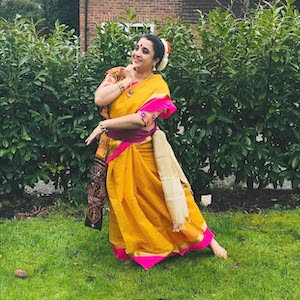
Bottom panel: Ananya Chatterjee, Kalakunj Performing Arts, UK. Vanessa Pesci: Dance Instructor, Lane Academy of Dance, UK and GCSE dance teacher, Sawston Village College, UK (image unavailable)

Acknowledgements:
I would not have been able to dive so deeply into researching the art form I love if it were not for my school’s Arts Development Manager, Mrs Morgan. Her guidance and support to help me complete this and all the other projects for my Gold Arts Award has been beyond my capacity to put into words how much I appreciate her. Thank you.
I am immensely grateful to all my interviewees: Pushkala Gopal, Lucy Bayliss, Ananya Chatterjee and Vanessa Pesci. Pushkala Aunty, has been my examiner for some of my ISTD Bharatanatyam dance exams and she has always cared and supported me throughout my journey to progress in my dance. Lucy Bayliss, who I have met many times at DanceEast and has watched me grow and evolve as a dance student, was very eager to help and share her views for the essay. Vanessa Pesci, who was my GCSE Dance teacher and has given me a great insight into the world of western dance, willingly supported me for this essay. Ananya Chatterjee, who I have met virtually for the first time, has without fail helped me even though we have not met personally. I do hope I meet you face-to-face soon!
To my Bharatanatyam dance teacher, Krishna Zivraj who has been a driving force in helping me complete this essay and all the other projects for my Arts Award. Thank you so much for connecting me to all my interviewees and introducing me to Ananya Chatterjee and thank you for your guidance in helping me structure my essay and ensure my research on Bharatanatyam was technically correct.
I am deeply grateful to my English teacher, Ms Dolan who has guided me in structuring my paragraphs and has been so enthusiastic and extremely helpful in editing my essay.
I sincerely thank all the photographers for all the beautiful images I have displayed throughout my write-up.
And finally, my Dad, who has thoroughly edited my essay since the beginning and has revised this essay to perfection. Thank you so much Dad!
Online Bibliography:
https://dictionary.cambridge.org/dictionary/english/classical
https://en.wikipedia.org/wiki/Rukmini_Devi_Arundale#Legacy
https://medium.com/@tripatakadance/dance-legacies-rukmini-devi-arundale-c9f5f3fcf517
https://worlddanceheritage.org/bharathanatyam/
https://www.bhavans.info/about-bhavan/bhavans-abu-dhabi.php
https://en.wikipedia.org/wiki/Natya_Shastra
https://en.wikipedia.org/wiki/Tandava
https://en.wikipedia.org/wiki/Lasya
https://dbsjeyaraj.com/dbsj/?p=13551
https://en.wikipedia.org/wiki/Devadasi#Evolution_of_Bharatanatyam
https://www.akademi.co.uk/bharatanatyam-london/